A selection of our current exhibits
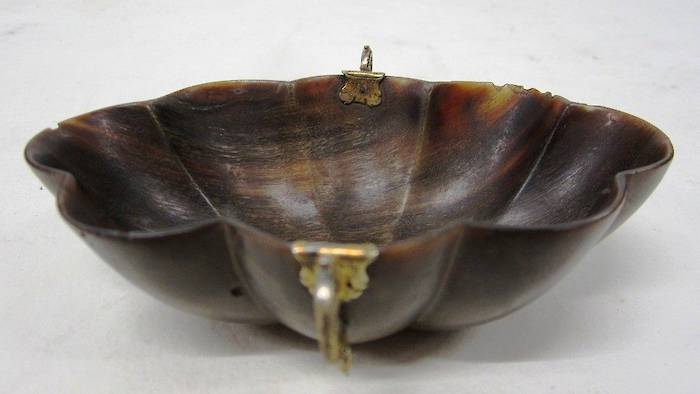
- Mary of Burgundy’s prayer nutUnique carving
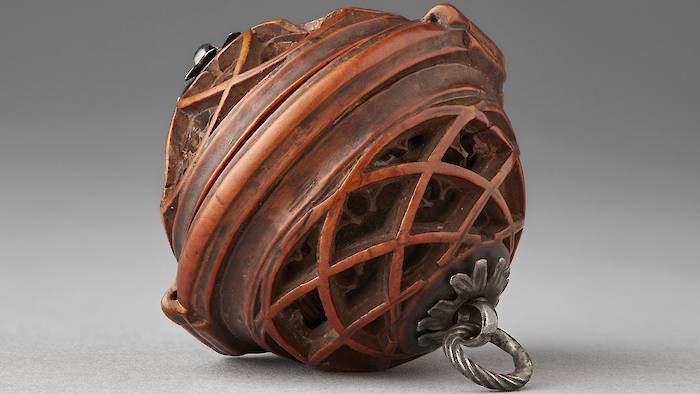
Mary of Burgundy’s prayer nutUnique carvingPrayer nuts are nut-shaped, carved capsules which open into two halves. They were mainly used from the late 15th century until the mid-16th century as pendants on rosaries or necklaces. The German term ‘Betnuss’ or ‘pray nut’ dates from the late 19th century and is probably a literal translation of the French term ‘noix de prière’.
The precious carvings are thought to have originated in Flanders. As this prayer nut is thought to.
It belonged to Mary of Burgundy, daughter of Charles the Bold and wife of Emperor Maximilian I and is extremely valuable. There are only a few examples like this left in the world. Although the rare art chamber object is only a few centimetres tall, its outer shell makes quite an impression with its lacework carving, as befitting the tastes and style of the Gothic Period. Inside are two significant scenes, delicately reproduced.
If you open the nut, one half shows a carved picture of John the Evangelist with St. Catherine and her sword, along with St. Barbara.
In the background on the right you can make out the tower in which St. Barbara is supposed to have been locked away by her father to prevent her from converting to Christianity. The tower has three windows, a symbol of the Holy Trinity.
As patron saint of miners, St. Barbara is important in Leogang. A tunnel was named after her and December 4, St. Barbara’s Day, was a main feast day for the miners here.
The second half of the prayer nut shows Mary of Burgundy with her husband Emperor Maximilian and St. George.
- Processional silver crossThe hallmarks’ message
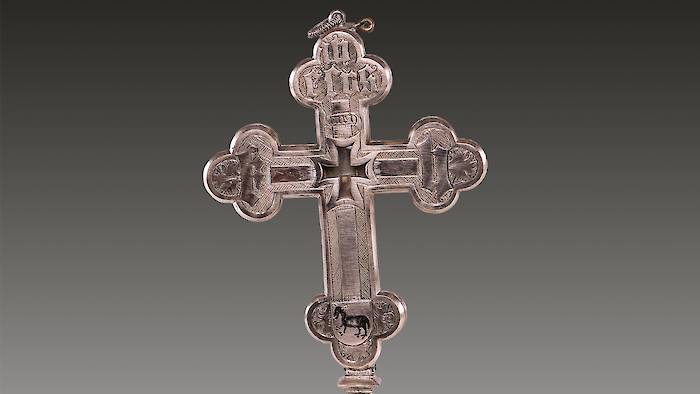
Processional silver crossThe hallmarks’ messageThe cross shown here is silver with hallmarks from 1805 or 1809. Stamp marks on metalwork objects usually certified their precious metal content. Further stamps had to do with legal stipulations.
The cross has an eight-piece foot with a double hallmark in the rhombus containing a large ‘C’s and another with an ‘8’, denoting 8-Lot silver. In addition, there is a stamp with crossed keys. At the foot of the cross is an inscription: ‘1470’ in Gothic numerals.
On the front of the cross, the ends of the top half branch out into trefoils. Trefoils are a common element of the late Romanesque and Gothic style and consist of three, outward-pointing circular arcs with the same radii as inscribed in a circle.
Left and right can be found the single letters ‘F’ and ‘H’ (probably the owner’s initials). At the top is the inscription ‘IH. CROS’, the abbreviation for ‘Jesus Christ’. The inscription ‘INRI’ (‘Jesus of Nazareth, King of the Jews’) can be found above a relic window in the shape of a Teutonic Order cross. The trefoil on the lower end is decorated with a black, wolf-like animal in a blazon. The ring at the top end once served to attach a securing tape to ensure the cross did not fall during prayer processions.
The reverse shows an engraving of St. Christopher with the Infant Jesus and has a removable piece of the True Cross under clear quartz along with the coat of arms of an unknown bishop.
The inscription ‘receptacle containing the confirmation from Rome of the authenticity of this piece of the True Cross’ can be found on the bottom plate. This was the certificate of authenticity of a relic issued by a bishop. The foot of the cross is hollow, presumably it once held the now-lost certificate. The processional cross comes from the Margarete Sperl collection. It was a gift from His Magnificence Günther Georg Bauer, privy councillor of Salzburg.
- Winged altarpiece from the Frey collectionLargest Gothic collection in Salzburg
Winged altarpiece from the Frey collectionLargest Gothic collection in SalzburgA particularly valuable exhibit from the Gothic Room of the Mining and Gothic Museum in Leogang is the winged altarpiece from the Frey collection. The first item from the Frey collection, it was acquired by friends of the museum in 2008 and then donated to it. Carl von Frey (1826-1896) was a successful businessman who, in the second half of the 19th century, assembled Salzburg’s largest private collection of Gothic art.
The altarpiece was probably built around 1520 in Lower Bavaria. The shrine, predella and wings are made in spruce and the sculptures in lime wood. The wings are painted on both sides. The interior shows St. Barbara and St. Margaret, each on a gold brocade background. The exterior shows the Annunciation. Below it, on the predella, is Jesus making a blessing gesture and holding a globe, along with the 12 apostles.
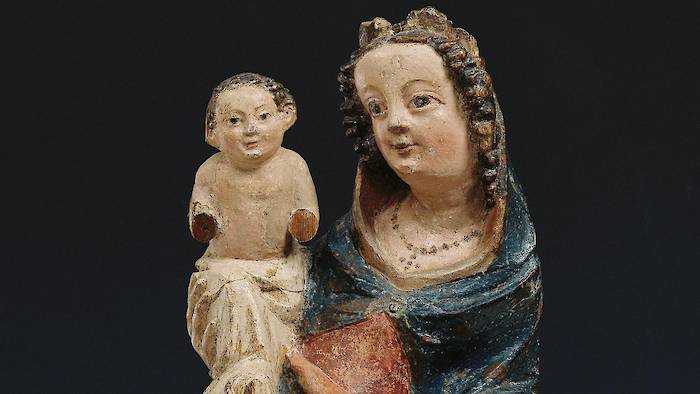
The shrine or ‘retable’ has been preserved more or less in its original state. Mary is standing in the centre of the base with the Infant Jesus. At her feet is a crescent moon. To the left and right of the Mother of God are St. Mary Magdalene and St. Catherine.
Mary corresponds to the Apocalyptic style of Madonnas with the golden rays on the back wall of the shrine symbolising the sun. Mary carries the lively, cross-legged Infant Jesus on her right arm, who is reaching with both arms towards his mother. In her left hand the Madonna holds a fruit which her child is trying to grab.
The Blessed Mother’s robes consist of a golden dress gathered below the chest with a round neckline and golden sleeves. A golden mantle hangs on her shoulders, the blue lining of which is visible in the drapery.
Folds fall in long lanes down to the base. Her oval-shaped, harmonious face with its high forehead is framed by open strands of hair that spill loosely onto the shoulders. The Madonna is wearing a leafy crown.
St. Catherine, occupying the place of honour on the right side of the Mother of God, holds a sword in her left hand. There is a broken wheel at her feet – a symbol of martyrdom. In her right hand she is presenting an open book. On her head is a simple gold crown. The rich folds of her golden mantle reveal its green lining as if swept up by a gust of wind.
To the left of the Blessed Mother is St. Mary Magdalene. She is wearing a veil placed carefully on her shoulders and holding a golden, tapered anointing vessel with both hands.
The winged altarpiece from the Frey collection was exhibited in Salzburg in 1888 at the 40th anniversary of Emperor Franz Joseph I’s coronation.
The oldest representation of an Apocalyptic Madonna is the Crescent Moon Madonna in Hortus Delicarium by Herrad of Landsberg. The image of the Crescent Moon Madonna goes back to the account of John’s vision of a cosmic, pregnant woman crowned with stars and clothed by the sun with the moon beneath her feet, who is menaced by a dragon following an apocalyptic battle between the dragon and the Archangel Michael.
Our Museum Audio Guide
Interested in our exhibits?
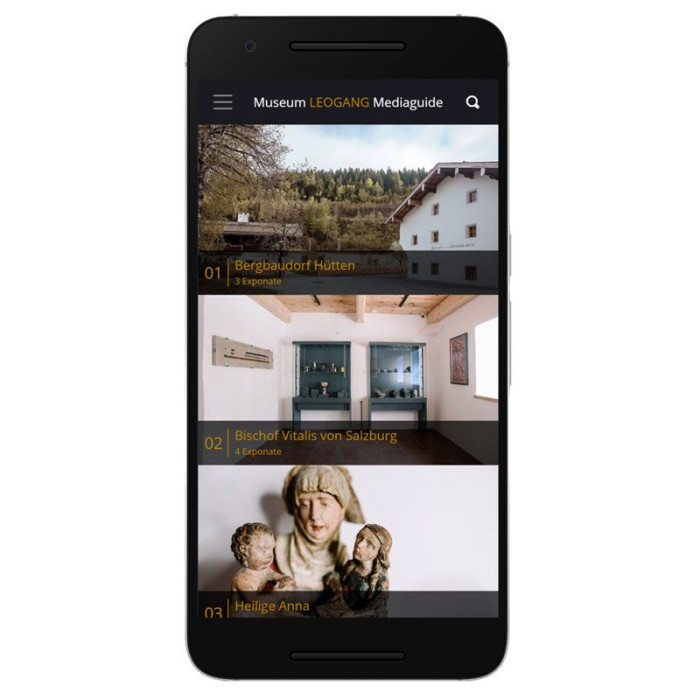
Our free media guide provides fascinating information.
Have a look: Audio-Guide